
← Back to News
Published on 17/09/2026
Bioceanic Route Expands Investment Prospects in Paraguay
New highways and double investment grade enter corporate assessments; logistical gains will also depend on integration between Brazil and Paraguay
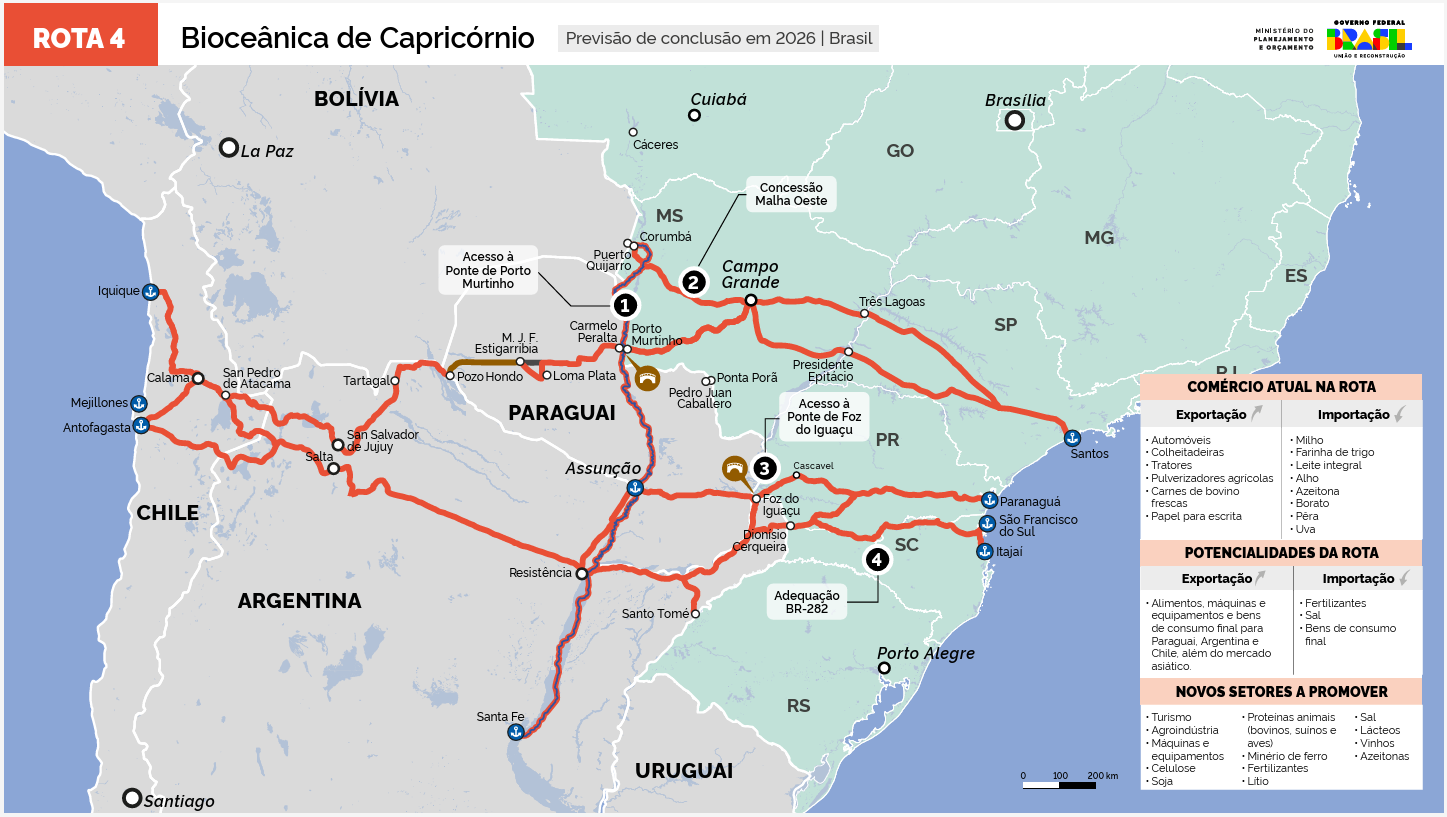
The advancement of the Bioceanic Route is beginning to produce effects that go beyond the construction of a land connection between Brazil, Paraguay, Argentina, and Chile. In Paraguay, the corridor is becoming part of a broader infrastructure network that connects producing regions, borders, waterways, and new industrial and logistical hubs.
One of the central structures of this transformation is the international bridge between Porto Murtinho, in Mato Grosso do Sul, and Carmelo Peralta, in Paraguay. On the Paraguayan side, the PY15 constitutes the main axis of the Bioceanic Route through the Chaco and advances toward the Argentine border.
According to official data from the Ministry of Public Works and Communications of Paraguay (MOPC), the first stretch of the PY15, between Carmelo Peralta and Cruce Centinela, approximately 174 kilometers long, has been completed. Another strategic stretch, between Mariscal Estigarribia and Pozo Hondo, totals approximately 224 kilometers and is still under construction.
The project creates a new perspective for regional logistics by establishing a land alternative between Brazilian producing areas and Pacific ports. Studies supported by the Inter-American Development Bank (IDB) also analyze the challenges of infrastructure, logistics, connectivity, and value chain development along this corridor.
Paraguay structures a new logistics network
The Bioceanic Route is not an isolated movement. Other works are beginning to modify Paraguay's internal connectivity and the capacity to transport its production. Among them is the so-called Ruta de la Leche, the name by which the Agro-Industrial Corridors of the Western Region have become known.
According to the Paraguayan government, there are approximately 188 kilometers of infrastructure in the Chaco. The Presidency of Paraguay itself links this corridor to preparing the region for the growth in truck traffic heading to Pacific ports via the Bioceanic Route.
In the Eastern Region, the Ruta de la Integración (PY10) represents another relevant axis. Official data indicate approximately 64 kilometers of main corridor between Guairá, Caazapá, and Alto Paraná, crossing a region with more than 250,000 productive hectares and an estimated movement of 1.5 million tons of cargo per year.
Together with the PY02, the waterway, the new bridges, and other corridors under development, these investments are beginning to form a new logistics network within Paraguay.
Double investment grade expands international attention
This infrastructure transformation is taking place at a particularly important moment for the Paraguayan economy.
Paraguay currently holds investment grade granted by two of the three main international risk rating agencies. Moody's maintains the country's sovereign rating at Baa3, with a stable outlook, a classification ratified in July 2026. Standard & Poor's raised Paraguay to BBB-, also with a stable outlook, in December 2025. Fitch maintains the country at BB+, with a positive outlook, just one level below investment grade.
According to the Ministry of Economy and Finance of Paraguay, the assessments consider factors such as economic growth, macroeconomic stability, relatively low levels of public debt, fiscal discipline, and greater resilience of the economy.
For businessman Jonathan Roger Linzmeyer, founder and president of CN Mercosul, in Paraguay, and founder and president of Grupo Linz, in Brazil, the combination of this international recognition and infrastructure investments is beginning to change the way companies and investors view the country.
“We are not just talking about a new road. When we put on the same map the double investment grade, industrial expansion, Maquila, the new bridges, and the logistics corridors, a new economic geography begins to emerge within Paraguay,” says Linzmeyer.
Private capital begins to follow infrastructure
This perspective is also at the origin of FIIPY, a private real estate investment fund founded and conceived by Linzmeyer in Paraguay, focused on structuring investments and developing real estate projects, including industrial and logistics condominiums in different regions of the country.
The thesis follows a consequence of industrial growth itself. New companies demand structured land, warehouses, distribution centers, storage, energy, services, and logistics infrastructure.
“The challenge is to identify where there will be real economic demand. Infrastructure creates new possibilities, but real estate and industrial investment must be supported by viability and a long-term vision,” emphasizes the businessman.
The movement is also beginning to appear in the decisions of Brazilian companies. In August 2026, executives from Grupo Schulz participated in a meeting with the Ministry of Industry and Commerce of Paraguay to evaluate opportunities related to the possible installation of an industrial plant in the country. The meeting was part of an evaluation process, with no announcement or confirmation of investment, and was conducted by Linzmeyer through CN Mercosul, with institutional support from Rediex.
According to the businessman, the discussion about Paraguay is becoming more sophisticated.
“For a long time, the analysis was concentrated mainly on taxation and costs. Today, logistics, location, raw materials, market, distribution, and international access come into play much more strongly. The Bioceanic Route adds an important long-term variable to this decision.”
The challenge is to transform a corridor into development
Despite the prospects, the economic effectiveness of the Bioceanic Route will depend on factors that go beyond road works. Customs structures, border times, integration among the four countries, security, transport availability, and port capacity will be decisive in measuring the real gains in competitiveness.
For Paraguay, there is an even greater challenge: transforming its geographic position into value generation within the country itself. “The great opportunity is not simply having trucks crossing Paraguay. It is being able to transform this infrastructure into industry, logistics, investments, jobs, and development. If that happens, the impact of the Bioceanic Route will be much greater than simply shortening the path to the Pacific,” assesses Linzmeyer.
The simultaneous advancement of the Bioceanic Route and different internal corridors, combined with the new level of sovereign risk achieved by Paraguay, places the country before a long-term opportunity. More than a new route, a new economic geography is beginning to emerge in the center of South America.
Jonathan Roger Linzmeyer
Jonathan Roger Linzmeyer is a businessman, founder and president of CN Mercosul, in Paraguay, and of Grupo Linz, in Brazil. He is also the creator and founder of FIIPY, a private real estate investment fund structured in Paraguay. Focused on developing real estate projects, including industrial and logistics condominiums, the fund follows the expansion of industry, infrastructure, and economic corridors in the country.
Technical and official sources: Ministry of Public Works and Communications of Paraguay (MOPC); Presidency of the Republic of Paraguay; Ministry of Economy and Finance (MEF); Ministry of Industry and Commerce (MIC); Rediex; Inter-American Development Bank (IDB); Capricorn Bioceanic Corridor; DNIT and Ministry of Transport of Brazil.
One of the central structures of this transformation is the international bridge between Porto Murtinho, in Mato Grosso do Sul, and Carmelo Peralta, in Paraguay. On the Paraguayan side, the PY15 constitutes the main axis of the Bioceanic Route through the Chaco and advances toward the Argentine border.
According to official data from the Ministry of Public Works and Communications of Paraguay (MOPC), the first stretch of the PY15, between Carmelo Peralta and Cruce Centinela, approximately 174 kilometers long, has been completed. Another strategic stretch, between Mariscal Estigarribia and Pozo Hondo, totals approximately 224 kilometers and is still under construction.
The project creates a new perspective for regional logistics by establishing a land alternative between Brazilian producing areas and Pacific ports. Studies supported by the Inter-American Development Bank (IDB) also analyze the challenges of infrastructure, logistics, connectivity, and value chain development along this corridor.
Paraguay structures a new logistics network
The Bioceanic Route is not an isolated movement. Other works are beginning to modify Paraguay's internal connectivity and the capacity to transport its production. Among them is the so-called Ruta de la Leche, the name by which the Agro-Industrial Corridors of the Western Region have become known.
According to the Paraguayan government, there are approximately 188 kilometers of infrastructure in the Chaco. The Presidency of Paraguay itself links this corridor to preparing the region for the growth in truck traffic heading to Pacific ports via the Bioceanic Route.
In the Eastern Region, the Ruta de la Integración (PY10) represents another relevant axis. Official data indicate approximately 64 kilometers of main corridor between Guairá, Caazapá, and Alto Paraná, crossing a region with more than 250,000 productive hectares and an estimated movement of 1.5 million tons of cargo per year.
Together with the PY02, the waterway, the new bridges, and other corridors under development, these investments are beginning to form a new logistics network within Paraguay.
Double investment grade expands international attention
This infrastructure transformation is taking place at a particularly important moment for the Paraguayan economy.
Paraguay currently holds investment grade granted by two of the three main international risk rating agencies. Moody's maintains the country's sovereign rating at Baa3, with a stable outlook, a classification ratified in July 2026. Standard & Poor's raised Paraguay to BBB-, also with a stable outlook, in December 2025. Fitch maintains the country at BB+, with a positive outlook, just one level below investment grade.
According to the Ministry of Economy and Finance of Paraguay, the assessments consider factors such as economic growth, macroeconomic stability, relatively low levels of public debt, fiscal discipline, and greater resilience of the economy.
For businessman Jonathan Roger Linzmeyer, founder and president of CN Mercosul, in Paraguay, and founder and president of Grupo Linz, in Brazil, the combination of this international recognition and infrastructure investments is beginning to change the way companies and investors view the country.
“We are not just talking about a new road. When we put on the same map the double investment grade, industrial expansion, Maquila, the new bridges, and the logistics corridors, a new economic geography begins to emerge within Paraguay,” says Linzmeyer.
Private capital begins to follow infrastructure
This perspective is also at the origin of FIIPY, a private real estate investment fund founded and conceived by Linzmeyer in Paraguay, focused on structuring investments and developing real estate projects, including industrial and logistics condominiums in different regions of the country.
The thesis follows a consequence of industrial growth itself. New companies demand structured land, warehouses, distribution centers, storage, energy, services, and logistics infrastructure.
“The challenge is to identify where there will be real economic demand. Infrastructure creates new possibilities, but real estate and industrial investment must be supported by viability and a long-term vision,” emphasizes the businessman.
The movement is also beginning to appear in the decisions of Brazilian companies. In August 2026, executives from Grupo Schulz participated in a meeting with the Ministry of Industry and Commerce of Paraguay to evaluate opportunities related to the possible installation of an industrial plant in the country. The meeting was part of an evaluation process, with no announcement or confirmation of investment, and was conducted by Linzmeyer through CN Mercosul, with institutional support from Rediex.
According to the businessman, the discussion about Paraguay is becoming more sophisticated.
“For a long time, the analysis was concentrated mainly on taxation and costs. Today, logistics, location, raw materials, market, distribution, and international access come into play much more strongly. The Bioceanic Route adds an important long-term variable to this decision.”
The challenge is to transform a corridor into development
Despite the prospects, the economic effectiveness of the Bioceanic Route will depend on factors that go beyond road works. Customs structures, border times, integration among the four countries, security, transport availability, and port capacity will be decisive in measuring the real gains in competitiveness.
For Paraguay, there is an even greater challenge: transforming its geographic position into value generation within the country itself. “The great opportunity is not simply having trucks crossing Paraguay. It is being able to transform this infrastructure into industry, logistics, investments, jobs, and development. If that happens, the impact of the Bioceanic Route will be much greater than simply shortening the path to the Pacific,” assesses Linzmeyer.
The simultaneous advancement of the Bioceanic Route and different internal corridors, combined with the new level of sovereign risk achieved by Paraguay, places the country before a long-term opportunity. More than a new route, a new economic geography is beginning to emerge in the center of South America.
Jonathan Roger Linzmeyer
Jonathan Roger Linzmeyer is a businessman, founder and president of CN Mercosul, in Paraguay, and of Grupo Linz, in Brazil. He is also the creator and founder of FIIPY, a private real estate investment fund structured in Paraguay. Focused on developing real estate projects, including industrial and logistics condominiums, the fund follows the expansion of industry, infrastructure, and economic corridors in the country.
Technical and official sources: Ministry of Public Works and Communications of Paraguay (MOPC); Presidency of the Republic of Paraguay; Ministry of Economy and Finance (MEF); Ministry of Industry and Commerce (MIC); Rediex; Inter-American Development Bank (IDB); Capricorn Bioceanic Corridor; DNIT and Ministry of Transport of Brazil.